
Description:
Part 1
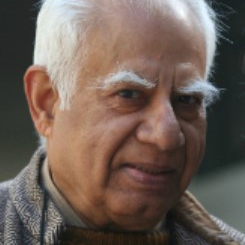
Dr. Shanti Tangri was born in Rawalpindi, India (now Pakistan) and raised in Lahore, India (now Pakistan). He grew up near what would become the India-Pakistan border in 1947. During the partition of India, he moved to New Delhi, India. He was in New Delhi for six years before emigrating to the United States via Europe.
Tangri received his Bachelor of Science in Physics and in Chemistry and his master’s degree in economics from East Punjab University (now Panjab University). He held various teaching jobs in New Delhi before leaving for the United States in 1953. After some time in New York, Missouri, Kansas, and Michigan, Tangri started his PhD program in Economics at the University of California, Berkeley in 1955. He received his PhD in 1961. He had several fellowships and teaching appointments until he was hired at the incipient Department of Economics at Livingston College at the Piscataway-New Brunswick Campus of Rutgers, the State University of New Jersey in 1970.
Tangri specialized in development economics and cultivated teaching interests in economic growth and economic development. He contributed to the establishment of the discipline at UC Berkeley. He was among the first PhD students in economics to take a field examination in development economics. He credits his first teaching opportunity and his first full-time job to his mentors, Gregory Grossman, a specialist in Soviet Economy, and Howard Ellis, a well-established name in monetary theory. He also recalls the day-to-day difficulties of living on a teaching assistantship salary as a PhD student.
Tangri speaks to his primary school education and hometown community. He first attended a primary school founded by Dev Samaj (Divine Society, an agnostic religious and social reform society). He then transferred to a primary school under the umbrella of Arya Samaj (Noble Society, a Hindu reform movement). He explains the meaning of the word arya in Sanskrit (noble) and the history and the reform objectives of Arya Samaj. He speaks to growing up within a very homogenous community of Hindus, Sikhs, and Jains where he can remember individuals very specifically for being Muslim. He attended DAV High School in Lahore, also founded by Arya Samaj. Throughout his education, he encountered much rhetoric on Hindu superiority and anti-Muslim sentiments.
Tangri reflects at length on the partition of the British Raj, the rule of the British Crown on the Indian subcontinent from 1858 to 1947, into India and Pakistan and the impact it had on the course of his life. He opines on the tensions between the Muslims and non-Muslims, and the conflict between fundamentalism and modernity. He summarizes his thesis in “Intellectuals and Society in Nineteenth-century India,” published in Comparative Studies in Society and History (Volume 3, Issue 1, July 1961). He remembers witnessing the violence by both Hindus and Muslims in the aftermath of the Noakhali riots. His family was displaced from Lahore, India, and scattered across India. Shanti Tangri recalls in detail his dangerous journey to Kashmir, a disputed territory between India and Pakistan.
While in Kashmir, Tangri met Mohandas Gandhi during Gandhi’s visit to Srinagar, Kashmir. Knowing that his brother was engaged at the time to Gandhi’s granddaughter, Tangri sought to ask Gandhi if he knows the whereabouts of his brother and their family. In recalling this, Tangri gives historical context to the partition of India into India and Pakistan and Gandhi’s position regarding the partition. When the Indo-Pakistani War of 1947-1948 erupted soon after, Tangri decided to leave Kashmir as soon as possible for New Delhi. Tangri first went to Jammu where he heard Sheikh Abdullah speak against religious fanaticism and make a case for Jammu’s place in India.
After a long, arduous journey, Tangri arrived in Delhi. Despite the hardship, Tangri considers his family’s circumstances lucky, as everyone survived. He became a community organizer in Delhi to get help for refugee students. He helped refugees have some privacy (tents in university hockey field), facilitated book donations from foreign embassies, and sought to create theater communities. He notes that such experience built his self-esteem and self-efficacy. Tangri changed his field of study from physics and chemistry to economics. He finished his bachelor’s degree in physics and chemistry in “camp college.” His university allowed students that were displaced by the war and unable to complete degree requirements to receive a conditional diploma if they engaged in university-approved social services for refugees and others in need. Tangri read broadly in economics, politics, and literature, including readings in Marxism and history of Marxism. He describes a few books that broadened his philosophical outlook.
Tangri recalls notable interactions he had before and during graduate school. Tangri describes his meetings with Mohandas Gandhi, Jayaprakash Narayan, Manabendra Nath Roy (M. N. Roy), Ellen Roy, and Jawaharlal Nehru. He gives some background on M. N. Roy’s contributions to the Communist International. He describes amusing anecdotes of his interactions with Ellen Roy in Dehra Dun, India and in San Francisco, United States.
Part 2
Shanti Tangri recalls how difficult it was to keep in touch with his family while he was in graduate school. He wrote letters to home. His father wrote back as he could write well in English. His mother did not speak English. Like most families in India, his family did not have a telephone at home. Tangri could not afford to visit home as airline fares were prohibitively expensive. He left a paper trail whenever and wherever he traveled sending a postcard or a letter home.
Tangri briefly speaks about his siblings. His father had seven children, of which four survived to adulthood. The oldest brother stayed in New Delhi with his own family. The remaining three left for the United States sequentially and helped one another navigate American academia. Shanti Tangri began his graduate studies in University of Missouri (Mizzou) as his older brother was a doctoral student in metallurgical engineering in Mizzou at the time. Similarly, his younger brother came to the U.S. for graduate studies in University of California, Berkeley (Cal) as Shanti was already at Cal.
In his last year as a graduate student at Berkeley, Tangri received a national fellowship at the recommendation of Professor Howard Ellis. The fellowship freed him from his teaching assistantship and allowed him to go to Massachusetts Institute of Technology (MIT) for the academic year ‘58-’59. Tangri also shares the wisdom he received from Professor Ellis, his committee chair, on establishing his credentials as a scholar before asserting strong policy positions.
Tangri recounts his job search as he wrapped up his PhD program. In his last year as a PhD candidate, he received a one-year job offer as an associate at Berkeley. After receiving his PhD, he received many offers from interdisciplinary and regional studies programs. He declined several of them as he wanted to find a position in an economics department. Tangri held two tenure-track jobs at the Southern Methodist University in Dallas, Texas from 1961 to 1963 and at 3 and at Wayne State University in Detroit, Michigan from 1963 to 1969. He also had an honorary appointment at the University of Michigan in Ann Arbor at the Center for South and Southeast Asia Studies. He recounts how the move was both a professional and a family decision as his wife hoped to get back into a graduate program in social psychology. Tangri left Wayne State University after six years due to intradepartmental politics, mismatch between his high expectations and the underperformance of undergraduate and graduate students, and race-inflected interpersonal conflicts.
Tangri was offered full professorship with tenure at Livingston College. He started at Livingston in 1970. As the chair and the only full professor in the Economics Department at Livingston College, he became very involved in building the department. He made difficult personnel decisions. He forcefully debated with his colleagues about pedagogy and education. Tangri reflects on the consolidation of the economics departments at Rutgers, Douglass, Livingston, University College, and Cook into a single department within the Faculty of Arts and Sciences. Tangri suggests that while faculty stature and graduate program improved, undergraduate education has suffered. He recounts several undergraduates from Livingston College whom he mentored and reconnected with post-graduation. He speaks in depth about what being a good, responsible teacher, academic, and colleague meant for him.
The Rutgers Oral History Archives received an operating support grant from the New Jersey Historical Commission, a division of the Department of State. In the 2024-2025 cycle, this grant assisted the ROHA staff in making this oral history available to you for your use.