
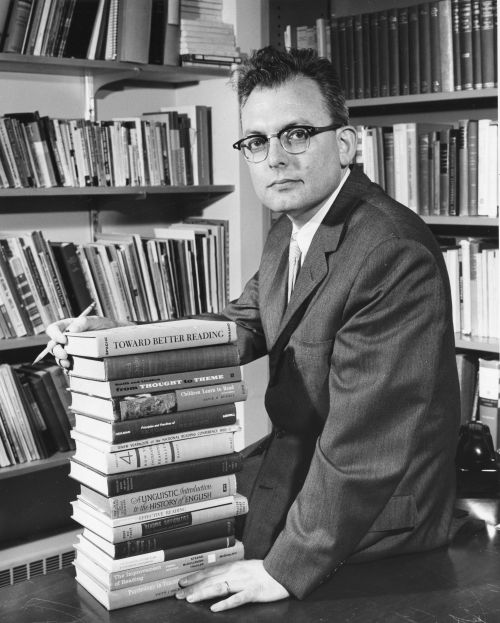
Description:
Dr. Martin Kling was born in 1928 in the Bronx, New York, to immigrant parents from Bialystok, then part of Russia/Poland. His father, Louis (originally Lazar), was a journalist for Yiddish newspapers such as The Jewish Daily Forward and an active union organizer for the International Ladies' Garment Workers Union. He also taught Yiddish and championed workers' rights during the sweatshop era. Kling's mother, Ginda Rosen, was a devoted homemaker who maintained a stable household during the hardships of the Great Depression. Yiddish was Martin's first language.
Growing up in a predominantly Jewish Bronx neighborhood, Kling graduated from Evander Childs High School in 1945, where he co-edited the yearbook and participated in clubs like Foreign Affairs. After high school, he chose the University of California, Berkeley, drawn by its reputation and affordability. At 17, he traveled cross-country by bus and supported himself through creative means--working for room and board and joining a food co-op.
Initially focused on experimental psychology, Kling's career trajectory changed after a chance enrollment in a summer course on the psychology of reading. His outstanding performance led to an assistantship at Western Reserve University's Reading Clinic, marking the start of his specialization in reading research. He later returned to Berkeley for graduate studies, earning his master's and doctorate while working on psychophysiological aspects of reading.
Kling's academic pursuits were interrupted by the Korean War. Drafted in 1950, he trained at Fort Ord and served as a clinical psychology technician in the US Army Medical Service. Stationed at the 14th Field Hospital in Korea, he confronted widespread functional illiteracy among Regular Army personnel. Tasked with improving their reading and supervisory skills, Kling developed instructional programs--an experience that reinforced his interest in adult literacy and education.
In 1965, after presenting his dissertation at a national conference, Kling was recruited by Dr. Edward Fry to join Rutgers Graduate School of Education. He became a co-founder of the Rutgers Reading and Writing Conference, which grew into a major professional development event attracting hundreds statewide. Kling directed the Reading Center and Clinic, training graduate students and shaping state certification standards for reading specialists.
As a professor and later Chair of the Department of Learning and Teaching, Kling championed interdisciplinary approaches and mentored countless students. He published extensively and secured major federal grants, notably for the Right to Read Program, which produced landmark research on reading theory and practice. He also helped establish the AAUP chapter at Rutgers to improve faculty conditions and served on national committees.
Retiring in 1991 as Professor Emeritus, Kling continued consulting, writing, and teaching adult literacy programs for corporations and schools. He remained active in professional associations and was honored for his contributions to reading education. Personally, Kling married Roslyn in 1958 after a serendipitous meeting in Riverdale, New York. They raised three children.
Photos from Dr. Martin Kling's Estate:


The Rutgers Oral History Archives received an operating support grant from the New Jersey Historical Commission, a division of the Department of State. In the 2025-2026 cycle, this grant assisted the ROHA staff in making this oral history available to you for your use.