

[Editor's Note: Mr. Vereen has provided a number of photos and documents to supplement his oral history. You can find them throughout his interview series transcripts as well as in this gallery on the Rutgers Oral History Archives website.]
Shaun Illingworth: This begins the third oral history interview with Mr. Fred Vereen, Jr., on April 16, 2024, in Lawrence Township, New Jersey. Thank you very much for sitting down with me again.
|
|
|
 Figure 1: Mr. Vereen's father and brothers (1958),
  Figure 2: (L-R Sitting) Frank "Big Ed," Ellen (mother), Mae Vereen Harley, James & Dorothy Vereen, (Stand. L-R) William Holmes, Donald & Leola Vereen Ford, Margaret Vereen, Helen Vereen Holmes, Olivia Vereen Leggett, John Harley, (Back) Fred Vereen Jr., Oliver "Buckie" Leggett, Harold & Joyce Vereen
I wanted to start this session by asking you to tell me a little more about the history of the home that we are conducting the interviews in. We have been talking a lot about the neighborhood and how the area has changed. Your house was obviously a part of that--tell me a little bit about how you came to possess the house, what you have done to it, things like that.
Fred Vereen, Jr.: Okay, well, I guess I really want to start with the house that we moved into in 1941. The little house, I mentioned that before, but I don't think I told how my father purchased that house.
As I said, we lived in Trenton. We lived in a rowhouse. My father and mother were country folks. So, my father bought this house, a little house. I think his vision was the land, because the house wasn't hardly anything.
The house was--I figured out the square footage--a total of 698 square feet, for eight siblings and Mom and Dad. That's ten people squeezed into the room that we're in right now, that I'm being interviewed, and with my kitchen, is a little more than the six hundred square feet that we had to live in, a house.
I had my office next-door. Just before I retired, I had a garage attached to this house. So, I went ahead and got my office, refurbished my garage to an office. In moving the material, all my files and things, I found my father's original mortgage to that little house and the blueprint of the property with the little house on it.
I was amazed that he paid six hundred dollars. Now, this is in the [text] and, actually, I don't know how I got [it]. I don't remember anybody giving me these documents. I just happened to find them.
The mortgage, he got the mortgage from a savings-and-loan outfit, right here in Lawrence. It's in Lawrenceville. That was in 1941. Even my mom signed the documents and he paid six hundred dollars for the property and the house. He paid a hundred dollars down and he had to mortgage the five hundred dollars. He had to pay six-percent interest at the time and he paid two dollars and fifty cents a month. Then, he had to buy ten shares into the organization, and that was attached on to his two dollars and fifty cents.
I sort of figured it out--he wasn't paying much on the principal. I was eight years old when we moved back into that house in '41. I can remember going up into Lawrenceville, when I had my driver's license, to still pay them on this mortgage. Now, I don't know whether my father might have refinanced or what, but he was still paying them on our mortgage. It was amazing. Then, as I read through the documents--can I read a couple pages?
[Editor's Note: Lawrence Township is a township in Mercer County that borders Trenton to the northwest. Lawrenceville is a community within Lawrence Township.]
SI: Of course, yes.
FV: When I read through the documents, as it said, "The purchasers shall pay interest on said sum of five hundred dollars to be computed from the first date at the rate of six percent and in monthly installments of two dollars and fifty cents."
Then, what really got me--and, as a kid, you don't think [about it]--but I remember that little house and it was terrible. They have, in this document, that, "A, he has to keep the building in good repair," and that building was falling apart to start with. He has, "to not suffer or permit any damage to said premises and to not allow the building to become vacant or unoccupied."
It just tells me now what they actually thought of our folks back then. I mean, here's a building that, as I remember it, you couldn't live in it today, in this community or any community, the way that place was.
[TAPE PAUSED]
SI: There we go.
FV: I know my father had, I think, his vision (and, really, what did happen), was to build another house on that lot, but we lived in that house, oh, until I was a teenager, until I was able to work and help us finish the other house, but it was a sad situation.
I mean, we're fortunate that we didn't eventually get burnt up in that little house. In this area during that time, we generally had, every winter, there was a fire in this community. Because we had no fire hydrants, no water, no water lines, a couple times, people burned up in their houses in this community.
I think what happened, my father instilled into--there were four boys and four girls in my family--he instilled in us the desire to build our own houses, because each of the boys built their own house. My next to oldest brother, eventually, he ended up building three houses. He built the house next door, which I now own and I rent out. He built the house, a bungalow, right here, where this house is now.
That's how I came to get this house. He built the bungalow here, on this street, first. Then, he built the house next-door. He had a pool parlor, a pool hall, on the first floor and he built his living quarters up on the second floor.
SI: Yes.
FV: Then, he rented this place out. Unfortunately, while he was renting this out, this bungalow, it caught on fire. He told me that it burned pretty good. He told me I could have it. He said he collected insurance on it. He said, "If you want it, you can have it," and he said, "but you have to clear all the debris and whatnot." He gave me the lot.
So, what I did, I had a couple guys in the community and we hauled all the debris to the dump. I left three cinderblock walls standing. I went to the Township and I said, "I'm going to refurbish it." I got a building permit for refurbishing.
I didn't have to buy a regular building permit, that would've cost me more money. During that time, I got a building permit that cost me seven dollars and fifty cents. That affected the home, my tax structure, even when I completed the house.
So, it took me two years. I was working two jobs. It took me two years from the time I started to when I finished. I did a lot of work, a lot of work myself. I learned all the trades while building this house. I had a cousin who was a builder. He came in and he did a lot, helped me do a lot of the work, but he did it on his spare time.
At the time, I was working up at the National Guard Armory. I used to take the trash. I used to drive a little pickup truck and I used to take the trash to the dump. During that time, old brick wasn't the thing. You didn't see people, contractors, using old brick. They were demolishing houses in the Trenton area and other areas. They would take all the old brick and they would bring them to the dump and dump them.
Every time I went to the dump, I'd load them into the little pickup truck. I would bring it to the lot and dump them out. In my spare time, I would clean the brick. A young man, who I'd like to talk about later, Douglas R. Dickerson, who lived in the community and knew the family well and they knew me, I used to pay him so much to help me clean the brick.
Douglas, later, at nineteen, went into the Army during the Vietnam War and got killed. He was some of the first men to get killed in the Vietnam War. We later named the little center, memorialized him, his name, called it the Douglas R. Dickerson Community Center.
[Editor's Note: US Marine Corps Lance Corporal Douglas R. Dickerson, Jr., was killed-in-action in Quang Nam Province, South Vietnam, on August 15, 1967. Lance Corporal Dickerson was eighteen years old and a graduate of Trenton Central High School.]
Then, as I went along, there was another friend of ours, friend of my brothers and friend of my family, who did masonry work. They did all the masonry. During his time, when he was working, he had big contractor jobs, but he would bring his men, from their work and in the evening, he'd work two or three hours putting the brick around the house.
So, all the old brick you see around my house here came from the dump. He didn't charge me that much, but that's how I finally [did it]. I started building this in, I think it was '64, and I finally moved into it in '66. I laid all the hardwood flooring by myself--not by myself. Every once in a while, I'd have a brother-in-law [help] and my younger brother would help me. The sheetrock, all the sheetrock in this house, I laid up.
It was a real experience. I think it helped me, as I got into the housing management field, to know (to have experience of) what had to be done. It's the same way, as I say, that, even though I didn't go to college, I got all my expertise into the management field, even when I was working up at the Armory, in painting and cleaning and cutting grass. The biggest part of managing is maintenance and making sure your development looks good all the time, making sure you know your maintenance men, giving them your philosophy.
I liked to tell my men, I said, "You have to keep your grounds and your outside appearance. That's number one. That's the first thing that people see." So, I like to think that my experience from building my own home, my experience of working up at the Armory, was my schooling for what I was later to make my living at.
SI: I wanted to also ask about, getting into the larger neighborhood, the businesses that were here and the people that ran them. You had told me, when we were touring the neighborhood, about your uncle's general store. You just mentioned the pool hall next-door. There was the Crossing Inn. Tell me a little more about the various businesses and people behind them.
[Editor's Note: The Crossing Inn was a restaurant and bar in Lawrence, New Jersey, that hosted famous musicians.]
FV: Well, yes, when I was a kid, there was seven Black-owned businesses in this little neighborhood. The first one that I got started with was William Walker, called him "Buddie" Walker. Buddie came home, when he came home from [the service]. I didn't know the family at first, he didn't know me. He bought a property on Eggerts and Drift and he built a gas station. On the first floor was his business and he built his home on the second floor.
When he first started, me being the curiosity kid in the neighborhood, I started hanging around and helping him do whatever I could do, but he just let me hang around. He had bought an Army jeep while he was building his business and home. I wasn't old enough to drive on the road yet, but he let me drive it around the property.
So, once he got the gas station (and he was a good mechanic), I used to pump gas. I started working for him. I'd pump gas, take care of the store, the store part of it. I got so I could change tires and I got to the point where he trusted me to change oil.
During that time, cars had fittings, grease fittings, at the front of the car. So, we used to put them up on the hoist and I would grease the cars and change the oil. Then, later on, when he'd get sick, he'd let me--I'd run the gas station as I got a little older. He'd trust me with his money.
The other person that I was working for was Ed Falwell, Arthur Falwell. He had an ice business. During those years, most families had iceboxes. There were very few refrigerators--not only here, but all through Trenton.
He had two trucks and I worked with the fellow on his second truck. His name was Dick Pullen. Dick would drive. His biggest route was in the City of Trenton. Later, I started working with Mr. Falwell. I'd get a dollar. I got three dollars a day on Monday, Wednesday, Friday and Saturday.
Then, on half days, on Tuesdays and Thursdays, I got one dollar and fifty cents for a half day, he only did the bars, because, during that time, bars didn't have refrigerated coils or nothing. You had to chip ice and fill the coils and where the beer was, the bottled beer, with chipped ice. So, we serviced the bars on regular days, too, but you almost also had to service them six days a week.
Then, as I got older and I got my driver's license, I used to drive a truck on my own. I still got the same pay, even when I was driving the truck. I would drive a truck on [those days] and service bars by myself. I'd get a dollar-and-a-half, I look back, a dollar-and-a-half on short days and three dollars a day [on full days].
I can remember, when I was still going to school, I'd work on Saturdays with him. I can remember, six o'clock in the morning, coming on, in the winter, it was cold and you're handling ice. During that time, there was three major icehouses in the city and, like I said, hardly anybody had a refrigerator during that time. So, he had a good ice business.
Then, the other people I used to work for, A. C. Brown and my older brother, one of my older brothers, the one who built the house, they got the garbage pickup for the Township. They got the contract for two years. Me and my younger brother, we worked. We couldn't work during the week, because we were in school, but we worked on Saturdays.
With the ice route and going with the Township, picking up garbage, you got all over the town, I mean. You got to see how other people were living, their houses and their community. They had streets with curbs and sidewalks--here, we had none of that stuff. During the winter and summer, when it rained, the water just stayed in the streets until it dried up. In the winter, you had mud.
Where we lived, we had nothing on our road. It was just a plain road. You would think you were down South somewhere. You had mud when it rained. It's a good thing we didn't have many cars during that time, because, during the summer, if we had the traffic we have now, I mean, you would be loaded with dust.
Later, even in the '80s, while I was living at this house, all we had was a hard surface with no curbs. We still had areas where water laid in the streets. During that time, the bus service used to circle up my street. Every time the bus came by, you had the fumes from the diesel and it created dust. It was terrible.
Even then, I used to go to town hall and get after them about spreading more blacktop on the roads here, because, when the bus came, you had enough area where there wasn't any hard surface, like where you still had dirt, that created a lot of dust.
So, by going through the town, you're seeing all these beautiful, landscaped properties. You said, "My goodness." Then, you come back to your community and you say, "It's unbelievable, the way that we're living."
SI: You mentioned earlier the lack of fire hydrants and water to fight fires. That is another example of how this neighborhood was being neglected, I guess. Were there other examples that come to mind, of lack of infrastructure for things that you saw in these other neighborhoods?
FV: Oh, yes, I mean, we didn't have sewer. Most people had outhouses, including my family. I'd say our well wasn't no more than twenty-five, thirty feet from the outhouse. For folks who don't know what an outhouse is, that's your toilet.
You didn't have an artesian well, which they're eighty, ninety feet deep. You had a hand-dug well, which was no more than twenty, twenty-five. So, you got a lot of surface water that you had. I can remember my father putting bags of lime down into the well. Every time you had a rain, you'd get cloudy water that you drank.
So, everything--we had poor street lighting. We didn't have appropriate street lighting in this area. Everything that the outside communities had, we were lacking and it showed. So, when I got old enough, I started going to town hall, challenging them and saying, "We want our community to look like [the rest] and have the same amenities that the rest of the town has."
SI: When did they, for example, put in the fire hydrants and things like that?
FV: It didn't happen until, believe or not, the '80s.
SI: Okay, wow.
FV: We got sewer. Then, we started getting--Public Service put in the gas lines. Folks who had inside plumbing had a cesspool. They had to have it dug on the outside, a hole that accumulated your runoff from your house, your plumbing and your inside toilet. Then, that had to be pumped out. That was another business here in this community.
A gentleman that lived right in back of me, he had cesspool trucks that used to pump out the cesspools, not only the ones in this community, mostly people [in] the town, at that time, didn't have sewer either, but people had cesspool systems.
We were the last area to get a sewer system put in and the last area in the town to get water. Even the community, that little community, Eldridge Park, that's right adjacent to us, that had Blacks and whites living together, they had the conditions. They had sewer. They had a drainage system. We didn't get a proper drainage system until the '80s.
When we built Eggerts Crossing Village, we moved the first tenants in in 1974. In '75, we had a real big rainstorm. All the water from up this area would just flow right down into the Village, because right behind the Village, there's a creek. That creek would overflow. We had six feet of water in one of our buildings down in the Village.
That's when the town put in--I think I said this before.
SI: That is okay. This is a different context.
FV: Yes, okay.
SI: Yes.
FV: That's when the town put in a drainage system. Well, they told us, the Board at the Village, Lawrence Non-Profit Housing, Inc., who was the sponsor of Eggerts Crossing Village, Lawrence Township came to the Board and they said, "If you will let us use some of your land, we'll put in a larger drainage, a detention basin. We'll put a drainage system in this area," in our area, "so that the water would flow into that larger detention basin."
So, we had extra land when we bought the Village. When we bought land for the Village, it was twenty-six acres and we only used thirteen acres to build the development on. So, we had twelve extra acres. We let them build that. That's where the landfill came to fill in the track bed that's now the walkway.
So, we got a proper drainage. After we've got the drainage, that's when--it was years later that they finally put in the water system, then, Public Service. That's when they improved the roads with curbs.
Our first roads, my brother and I, back in--I was President of the Civic League at the time--our first road was in the late '60s. I went to the town and told them how we wanted our roads improved. They said, "Okay, we'll start with one road." That was Johnson Avenue, the road next to the track bed, the railroad tracks. They said, "We'll start with one road in your community," and we said, "Okay."
They said, "The first thing you have to do is, you'll have to get a petition signed by the residents on Johnson Avenue, that they know that they're going to have to be responsible for the curbs and the sidewalks." They didn't [think it would work], because it was all Black folks there, who had minimal means, and to go to them and say, "You're going to be taxed for curbs and sidewalks," even we weren't sure how they were going to react.
I know the people at townhall, they figured we were going to have a problem in getting people to sign, but, fortunate enough, when we knocked on doors, they didn't question us at all. They signed the petition and Johnson Avenue was the first road to have hardtop and curbs and sidewalks. That was, again, in the late '60s. Then, we didn't get the other roads in this area done until the '80s.
SI: You had told this story--I think it was in relation to the master plan at one point--where you used the political power of the neighborhood to get it changed, so that this was not going to turn into a light industry area.
FV: Right.
SI: Were there other times when you used that kind of political power to try to move some of these things along?
FV: No, I think each time we tried to do something, the powers-to-be seemed to forget what you did the last time. They made you go through all the changes again. The next big thing--well, we got them to go along with developing the Neighborhood Center.
They bought into that, but that was a process that had more white people involved than [non-white], and the churches and various organizations involved, because they wanted to help this neighborhood. When we went through trying to get the housing, Eggerts Crossing Village, built, that was a political process, that both parties, actually, didn't want it.
We just had to deal with getting more community people involved, and that's what we did. That's when we got our plans and the core group together, when we sent out an announcement that any group or any organization or church that wanted to hear what we were trying to do, we'd come to speak to them.
That process really, really helped us when we started having large meetings and Planning Board meetings--even though the larger turnout was people who opposed it--but you had your core group who were really adamant about wanting to do this and who could speak up. They were the ones who would go to small meetings at Township and put pressure on Council people and Planning Board people.
At the general (the larger) meetings--we had some--our meetings were at the high school auditorium. Well, the junior high--the high school hadn't been built yet--but, at the junior high school auditorium, we had to have all the meetings there, the Planning Board meetings and the Zoning Board meetings, because of the turnout of the people opposing building that housing.
SI: Going back to the idea of there being a lot of fire damage because of the lack of infrastructure to fight them, would a fire department come out like any of the other houses in town or did you notice that there was less of a response (or no response) in the neighborhood?
FV: Oh, yes, no, they came when there was a fire. Your fire companies then were volunteer fire companies. It took them time to gather themselves, but, no, they responded. The problem was, these houses weren't much to them anyway. They were all all-wood, paper-thin. Once one got on fire, there wasn't much saving.
I can remember, when I got older, when we used to play, when the Recreation Department started having baseball teams, competition in different areas of the town. We had our team here in Eggerts Crossing. The first couple of years, we won the championship. There would be about four or five teams, but the one team had the guy, the man, who was, more or less--he wasn't the head of, but he had a lot to do with the local fire department, the volunteers and whatnot.
He and I became, not friends, but we became good acquaintances. So, one day, I asked him, I said, "How about some of us joining the volunteer fire company up there?" That's up on [Route] 206 now. He said, "Fred," he said, "why don't you guys start your own volunteer fire company?"
I said, "How in the world can we start our own volunteer fire company?" I said, "It doesn't even make sense for you to ask it, to say something like that to me." It just shows they had no thoughts or no consideration of our needs or our desire, or their desire to get us incorporated in anything that they were doing.
Then, [in] later years, when they wanted to get Blacks incorporated into the fire company, they wondered why we weren't coming there, when there was no effort on their part to get us into them when we wanted to.
SI: Wow. Is there anything else you want to cover before we get into St. James Village? We can always go back, obviously.
[Editor's Note: St. James Village is an affordable senior community in East Windsor, New Jersey.]
FV: Yes.
SI: I do not know if you want to pick up that thread.
FV: Yes, okay.
SI: You had told me last time about getting involved in Architects. You had to get some kind of accreditation or something to run multiple sites.
[Editor's Note: Architects Housing is an eight-story affordable, subsidized, senior citizen housing apartment complex in Trenton, New Jersey.]
FV: Yes, yes.
SI: You had that by the time St. James came about.
FV: Yes. Well, in St. James, like I said, it just seems like it worked out, that we opened up Eggerts Village in 1974, and then, five years later, in 1979, I opened up Architects Housing in Trenton. Then, there was a church in Hightstown, New Jersey, that I don't know how I got in contact, a Black church, an AME [African Methodist Episcopal] church, that wanted to build some housing for seniors.
So, I contacted the Minister. By then, I had gotten knowledge of consulting and what it took to get an organization, even a church, started into--if they wanted to, it wouldn't cost them any money--into the New Jersey Housing Mortgage Finance Agency. So, I went to them.
I met with them and I said, "The first thing we have to do, you have to become a non-profit, a 501(c)(3)," and they did. We submitted applications to HMFA. There was a local farmer that had property. I met with him and he gave us the property. Well, he didn't give it to us, but he turned the property over to us. Then, once we got our mortgage, he was paid for the property.
I started with them from the ground floor, met with the church. We got members as board of directors. Then, we got a developer. During that time, a developer would come in and work with the non-profit. The non-profit would manage the development and he would do all the financing and whatnot through HMFA.
[Editor's Note: St. James AME Church is an African Methodist Episcopal church in Hightstown, New Jersey, that was established in 1868. The New Jersey Housing and Mortgage Finance Agency (NJHMFA) is a state agency that helps those in need gain access to affordable housing through a number of programs.]
I guess it took us about two years, two or three years. After we built it, they hired me as the manager. The Minister at that time, well, first, he wanted--we were going to build a larger development, which was senior housing and family housing. We had all the things working for us, but the Minister, he didn't [support it].
We even had a couple contractors who had just completed some developments for the Housing Finance Agency. They were experienced. They had just finished one here in Trenton that I later managed. So, there was two developers waiting.
The Minister, one of the developers told our architect, John Svosec, who was later the architect for that St. James Village, John, who was also the architect for Eggerts, one of the contractors told John, he said, "John, I wouldn't want that development set if you guys approved me," he said, "because the Minister came to me and said he wanted one percent of the construction cost," which showed that the Minister wanted a contractor that he could deal with.
He just kept putting off the development from starting because he hadn't got the contractor that he wanted. I told the Minister, I said, "Look, we're going to lose the project," I said, "if you keep stalling this." He finally got a contractor out of Philadelphia and it worked out okay, but it showed that the Minister wasn't on the up-and-up.
We did lose the larger development. It wasn't a few years later until, finally (HMFA had some extra money), we got the senior housing, that there wasn't enough money to build any family housing. So, we finally got the senior housing under contract and that was built.
Then, I became the manager. I managed that for fourteen years. At the beginning, I wasn't sure that they were going to hire me because of the Minister. Now, this was an all-black group and I assumed that I was going to go from the consultant into the management, but I think the Minister was trying to squeeze something out of me.
He said to me (before they hired me), he said, "Well, what's in it for me, Fred?" I said, "Well," I said, "Pastor, we can hire you as a consultant, a social consultant, where you can do things for the residents. They're all seniors." He said, "Well, how's that going to work?" I said, "Well," I said, "you will no longer be President." I said, "You can't be President of the Board and still be employed." I said, "You have to take one or the other," but he wanted both.
I said, "You can't do both." He thought being President was more important to him than being employed, but they finally hired me, the Board and him. He still wanted something. I wouldn't give him five cent, because the minute I gave him a little, that would grow automatically. If HMFA found out that he was trying to do something and I was in it with him, they would've gotten rid of both of us. I told him, "If you want to get paid some money, then, you've got to do it above board."
I knew from the very beginning. The Developer was from New York and he had other developments. He came down; he wanted to meet. Now, this is during the process of financing the development. This is before anything was done. The Developer wanted to meet the President of the Board, who was the Minister. So, he came down from New York. I picked him up at the train station and I took him to the church.
He and the Minister met in the office without me. When he came out, he didn't say anything to me about what took place (and neither did the Minister), but he never gave the church anything. I mean, even to get the money for groundbreaking, for food and whatnot, was hard to get him to give anything, where, by rights, the church was supposed to get thousands of dollars as a write-off from the Developer.
Evidently, he had the Minister over the eight-ball, because the Minister must've asked him for something. If he had said anything that the Minister had made a request for funds, HMFA would've got rid of either the Minister or the Board or whatever. I knew something had happened in that office that made the difference, but I went on to manage the project for fourteen years.
I didn't have a good relationship with the Board, because, again, they thought they knew more than me, but I stuck it out for fourteen years with them. Then, the Developer said that he wanted to takeover managing himself with his children, but it was a good development. I had a good relationship with the outer [community]. It wasn't built in Hightstown; it was built in East Windsor. That's where this farmer had property.
SI: Yes. Where, roughly, was it built?
FV: It was built right off of Main Street in East Windsor. It borders Hightstown, but it was in East Windsor, right in.
When we built it, it was built right actually on a cornfield. We had to pay the farmer for the corn that was destroyed, but, if you go down there now, my goodness, when I go there just to see, look at the building, there's houses all around it. I mean, all the fields are houses now, townhouses, but it was and still is a good development. I think we had 102 units there.
SI: When you built Eggerts Crossing and Architects, you had faced people saying, basically, "We don't want African Americans moving in." Was there any of that with St. James?
FV: No, no.
SI: Okay.
FV: Because most of the people that moved in were white people.
SI: Okay.
FV: Yes. No, that's one place I didn't have [that issue]. There wasn't a problem of race [that] came up at all.
SI: You are now managing all three properties. Is that difficult? What does that do to your life?
FV: Well, it's not hard, because you have a staff at each development. Your staff runs the development based on your philosophy. I had my wife, was the site manager here at the Village. I had good people at Architects. I had my daughter down at St. James. Later on, I had my sister-in-law at Architects.
Then, I worked with another group, up in Passaic Township, and these were Township people. I got them through my architect, John Svosec. They formed a non-profit group. I helped them form a non-profit. We ended up building sixty-two units up there.
I didn't manage that [long]. I managed that for maybe about a year, because that was an all-white group that I was working with. We formed it and we built it. Once we did, once they got the place built, they didn't trust me. They knew more than what I knew.
I had an accountant who sort of followed me with my developments, too. They went up with me a couple times to meet the group. They told me, they said, "I don't see how you stay here, Fred." She said, "I don't see how you can put up with the stuff they asked you."
So, I got tired of it. It was about a forty-five-minute, an hour ride every day. I didn't stay there a year. I let them go. Then, I managed another place, North 25.
[Editor's Note: North 25 is an affordable apartment complex at 260 North Willow Street in Trenton, New Jersey.]
SI: Okay.
FV: That was horrible--you want to go into that?
SI: Yes, I noticed it was a very short period.
FV: Yes, well, North 25, that was a Trenton group. I always said I didn't want to get involved with the people in Trenton--and I'm specifically saying the Black people in Trenton--because they weren't trustworthy. They looked down on the people in the suburbs, especially out here.
The original President of that board was a friend of my family, my brother's and his wife, who was head of the NAACP in Trenton. It was built right after Eggerts was built and it had 225 units. It had a senior high-rise and a family development. They had a hundred units of family, I think, and they had 125 units of senior.
She came to me and they were having problems. They had a lot of money. They were having problems from getting managers. They'd go from one manager to another. So, the wife of the President, he had died and she came to me. She said, "Fred, we'd like for you to manage our development." I said, "Okay."
[Editor's Note: The National Association for the Advancement of Colored People (NAACP) is a national civil rights organization established in 1909. The Trenton Branch of the NAACP was established in 1913 and remains active today.]
So, I went there and I met the Board. They said, "There's one thing we do want. We have a person, our own person, for site manager." Now, the site manager controls your place. He/she runs your place. I said, "Okay, I can work with anybody," and I didn't know who it was. So, they hired me. I brought some of my people in. One or two of their people were still there in the office and the maintenance men.
The site manager they brought on was a good friend of the President and a number of the Board members, but he knew nothing, absolutely nothing, about managing a development. When they brought him onboard and brought me onboard, "This is your site manager," he says, "Fred, you don't need to be around," said, "I can take care of things." I said, "No, no, I don't operate that way." So, come to find out, he didn't know anything and they brought him in.
He was working with that Trenton Housing Authority. I don't know what he was doing over there, but he knew nothing about running a development like this. They had major problems. I went there and I worked my butt off, straightened stuff out.
At the time, they were getting a new heating system. They had two heating plants. The low-rises were across the street from the senior building and the senior building had its own heating system. They were replacing the old systems. They had hired the contractor.
When I first took over, I brought some of my staff there, my people. The project manager of the company that was putting in the heating system, I said, "When do you have project meetings?" He said, "Oh, we don't have project meetings." He said, "HMFA just lets [us handle that]. Whenever we want to have a meeting, we have it."
I said, "Oh, no, no," because anytime that work is being done, especially a major project, in a project, you have weekly project meetings. I started having weekly project meetings, which they didn't like. I told the Board. I said, "No, we have to know what's going on;" come to find out that the heating system in the low-rise, all the heating pipes were in the ground and they were losing umpteen water. They had leakage in all the lines.
So, I hired an engineering outfit that could come in and test, find out where the leaks were. They found out that they were not only losing hot water and building up their heating bills, but they were losing all this water. So, that was my first project, is getting those lines dug up and completed and fixed.
Then, the heating system, they had lawsuits against them. They were filing a lawsuit against a kitchen cabinet outfit that didn't complete kitchens. They had a fire in one apartment that they hadn't gotten money for from the insurance company. I mean, there was a whole lot of things, but the other thing, financially, it was the best paying project that I've had. I was making, as management fee, more money than I've ever made.
What really topped the cake with me was this site manager, of all the crazy things he did and things that he couldn't do. There's a process that when you have new tenants, your applications, you have your staff interview and there's paperwork that has to be completed and income verifications and all that stuff.
Then, you put this package together and you send it to HMFA, after you find out that the people are qualified. Before you send the paperwork to HMFA, you had to ensure that these people are qualified, financially and otherwise.
He gathers up all this raw information on these tenants, about ten tenants, and he takes it down to HMFA and leaves this package, without it being processed on our end. The people that I know at HMFA who process your paperwork, they called me and they said, "Fred, your man brought all this paperwork down here." He said, "What are we to do with it?"
I said, "What you do is, you send me a letter to that effect." I said, "I'll come down and pick that stuff up." I wanted to show the Board what was happening, and they just put it off.
What took the cake, what made me leave them (and I sued them), we had to get locks changed in the senior high-rise building. The locks, we had a locksmith come in. There was a set of keys that you always left with the security people, so that if anybody had to get in or [there was] an emergency, the security could let them in.
This Site Manager, he takes the keys home with him. One of the tenants called her daughter and she was having a heart attack. The security couldn't get in, because he didn't have any keys. They had to call the fire company to break the door down, so that they could get into this person's apartment. They got her into the hospital, but she died.
I went to the Board and I said, "I can't tolerate this person." I said, "This daughter," I said, "unfortunately, she didn't sue us," I said, "but she could have sued me, my management company. She could have sued you, the Board, and HMFA. She could've won, because she could've claimed her mother died because we didn't get to her in time," but this was a friend.
I said, "Well," I said, "I can't stay here." I said, "Money isn't everything." I left. I sued them, and I didn't sue them to get money, I just sued them for the principle of it. I didn't get hardly anything out of it. I didn't want anything out of it. I just wanted to let them know that what they did was wrong and what they were doing was wrong. They had no concern about the people living in that building.
So, I left after, I don't know, maybe a year, year-and-a-half, I guess, no more than two years, but I was glad to get rid of that. I knew most of the people on the Board, but they had to have it their way. I said, "Well, your way isn't the right way and I'm just not here for that."
SI: You have done a lot of consulting--and we can talk about that--but you continued to manage Eggerts Crossing and Architects. When did you retire from these positions?
FV: Well, I retired from Eggerts first. I think it was--what was it 2008? I retired from that first and I retired from Architects in 2016. I do remember that. That was the last one I retired from. I still serve on the Board on Eggerts. We started Every Child Valued, the after-school program, in--I'm trying to think. Boy, I'll tell you, I can't remember now. I think it was 2008 that I retired from Eggerts.
[Editor's Note: Every Child Valued is a non-profit organization in Lawrence Township, New Jersey, that provides educational enrichment programs within the public school district. It was established as an organization in 2009, but began as an after-school program within the school district in 2001. Mr. Vereen led its creation.]
SI: Okay.
FV: We had a fundraiser. Most of my fundraisers, I took those fundraisers and raised money for the after-school program and always had a big gala event. I don't know whether it was 2008 where I had my eightieth birthday at ETS, which was the first fundraiser for Every Child Valued. ETS was a big sponsor of our after-school program. We raised a hundred thousand dollars for our after-school program.
[Editor's Note: Headquartered in Princeton, New Jersey, Educational Testing Service (ETS) is a private educational testing and assessment organization, established in 1947. It produces and scores the SAT, GRE and other assessments.]
SI: Wow.
FV: But, ETS contributed a lot toward that. ETS paid for all the food, we didn't have to pay anything for the space, plus, they contributed to [the donation]. Through the sales of tickets and things, we raised eighty thousand dollars and ETS gave another twenty thousand for a hundred thousand dollars that we had for our after-school program.
Like I say, Architects was the last one that I retired from. I tell people that I had more time, believe it or not, when I was managing these developments than now that I'm retired, yes. I need to start work again. [laughter]
SI: You still had a lot of community activities, like working with Rider University and different things on the county level over the years. Are there any of those that you want to get into, that you are particularly proud of or found particularly interesting?
FV: Like?
SI: You have been on a lot of taskforces for Mercer County.
FV: Oh, yes, I was involved with, my goodness, the one that took a lot of my time, was the State Planning Commission.
[Editor's Note: The New Jersey State Planning Commission, a seventeen-member board, oversees environmentally-friendly development and redevelopment throughout the state.]
SI: Okay, yes.
FV: I was trying to remember the State Planning Commission. That was a real challenge for me, because, here I am, a high school graduate and no college experience. Everybody on that board, most of them had PhDs, all of them had master's, in the various fields. Randy Primas, who was the Mayor of Camden at the time, he was on it. There was quite a few guys. You might know one who's still with the Bloustein Foundation up at Rutgers.
[Editor's Note: Melvin "Randy" Primas (1949-2012) served as the Mayor of Camden, New Jersey, from 1981 to 1990 and was the city's first African American mayor.]
SI: Oh, the Bloustein School?
[Editor's Note: The Edward J. Bloustein School of Planning and Public Policy in downtown New Brunswick was established at Rutgers University in 1992.]
FV: Yes.
SI: Yes.
FV: Oh, what's his name? He's still there. He was part of the State Planning group. Matter of fact, he still contributes to our after-school program. I can't think of his name now.
SI: We can add it in later.
FV: Yes, but I learned a lot and I traveled a lot, throughout the state, organizations and towns and met with people, to inform people about the plan and what it was doing, what it was trying to do.
I was appointed by Senator Gerald Stockman, who was a good friend, a good friend of the family at the time. He thought that I could contribute a lot to the group, but you're sitting there with all these educated people. There was one lady, elder lady, who was on the group from South Jersey. I used to talk to her a lot. Of course, I used to talk to all, most, of the people and we were all [colleagues]. I got to know them.
I used to tell her how awkward it was for me to be in the company of all these well-educated. She said, "Look, Fred," she said, "you've got more common sense than anybody sitting around this table." She said, "What you have to say is not coming from a book--it's coming from what you experienced. That means a lot."
[Editor's Note: Gerald Stockman (1935- ) served in the New Jersey Senate, where he represented the 15th Legislative District, from 1982 to 1992, and also served in the New Jersey General Assembly from 1978 to 1982.]
SI: Yes.
FV: So, it made me feel a little better. [laughter]
SI: Plus, you were on the Commission for nine years, quite a long time.
FV: Yes.
SI: Particularly at the beginning, did you find that they needed your experience in terms of dealing with how various planning systems can be used to suppress people, I suppose?
FV: Yes.
SI: Tell me a little bit about that.
FV: Yes, I later wrote a paper regarding that. I emphasized one meeting we had in Newark. It's the only time, in many meetings--and I attended all the local meetings throughout the state. There were very few meetings that I missed. This was a meeting in Newark that had the most Black people that had ever been to a meeting.
They weren't concerned about future planning. They were there expressing their concerns of what's happening to them today--they don't have proper housing, their schooling. The members who did come to that meeting--there was only a few of us who attended that meeting--they didn't understand that these folks were living in today and not tomorrow. Their concern was, "What can you do for me now?"
That's something that needs to be built into the state planning. They didn't see how that was a productive meeting at all. I tried to explain that in my paper that I wrote, and how to get more Black people, minority people, involved into the state planning process.
I'd say that it's a process that you have to start with your local minority groups and churches. You have to go to them and explain the state planning process to them, to get them to help to get more Black people to participate in the state planning process.
I said, "Because planning, as Black people know it, in years, that's what," and I cite what happened right here in the City of Trenton, where all the rowhouses that were along areas in Trenton were torn down. They built a high-rise and put people into it. It has since been torn down, because it didn't work.
I said, "Because that's a planning process that we see, that Black people see. When you start planning," and it's the same thing that we said with what happened to our master plan here in Lawrence, "you're planning us right out of a process."
Miller Homes, they took people out of living in rowhouses and they put them in their Miller Homes, families who had never lived in a high-rise before, and they lost control of the kids. Like I say, it's since been torn down and they built low-rises, but that's the kind of planning that Black folks are used to.
[Editor's Note: The Miller Homes was a public housing complex in Trenton, New Jersey, that consisted of two ten-story towers that became notorious for crime and poverty. They were closed in 1989 and torn down in 2011. On the same land, the 204-unit public housing development Rush Crossing Apartment Homes was built, which opened in 2014.]
There's not that many Black planners. I cite in the paper that I wrote the number of Black planners in this state, which was very few. So, planning is not something that we're used to yet. Since then, we've gotten more people on planning boards and whatnot, and on zoning boards. During our housing, when we were fighting for the housing in the '60s, there was no Black people on planning boards or zoning boards. So, it's another area that we have to catch up on.
SI: Does anything else stand out that you want to talk about from your later years or post-retirement?
FV: Well, I mentioned earlier that, when I was at the Neighborhood Center, my second year or third year, there was a YMCA here in Lawrence that was run by another African American. They had a little shop, they had an office and it was financed by a couple grants.
Most of the people (well, all the people) on the Board were white, white men. They ran a day-camp for us here, for our kids, through the Neighborhood Center. Aaron Biddle, who also became Chairman after I stepped down and became Director of the Neighborhood Center, Aaron became Chairman of the Community Action Program. Aaron was also involved in track and field and he was an official. He used to officiate at the track and field games.
So, he said to me--this was during the time of the 1968 Olympics--he said, "Let's go to the Olympics." I said, "Okay." He made the reservations, we got tickets ahead of time, to various events, and we went. We spent three [weeks] in Mexico City during the time of the Olympics and had a good time.
The thing about it, he was short and, at the time, I was young and I looked like an athlete. We would go walk in town. He had a blazer with his emblem, track and field emblem, on it. So, it made him look like an official of the Games and I looked like an athlete. We'd have kids following us and I'd sign autographs.
We'd go into a restaurant or a bar and people would talk to us. So, he was a talker. He'd say to me, he said, "You shut up, you don't say nothing. Let me do the talking." [laughter] We made a lot of friends, because they assumed I was one of the track stars or something.
We were in the stands when Carlos and Smith won their race. We were sitting right in back of the podium in the stands there when they got up on it and raised their fists with their right hand. We had a good time. During that time, the gymnastics wasn't as popular as it is today. We had tickets. We had bought tickets for gymnastics and we didn't bother to go. The only things we went to was the track and field.
[Editor's Note: After medaling in the 200-meter sprint at the 1968 Summer Olympics, American gold medalist Tommie Smith and American bronze medalist John Carlos held up the Black Power salute as they stood on the Olympic podium.]
We did go to cycling. We saw some of those events, but we met some college kids who were attending college there in Mexico City. We treated them, and then, they invited us to--they had a little Volkswagen, there must have been about six or eight of them--but they invited us to dinner. They fixed a spaghetti dinner for us. We'd be walking along and Spanish people would stop and pick us up and take us where we wanted to go, but it was a good trip.
SI: I am curious, because it became such an iconic moment, what did you think at the time when you saw them giving the Black Power symbol?
FV: We had mixed emotions then, because we had not yet caught on to the moment. It wasn't until after we got home we realized what these guys represented and the message that they were giving and saying, but, no, we were still part of the old school, I guess. Those guys knew what they wanted and they were courageous in what they did.
SI: One thing I wanted to ask about before I leave is your efforts to honor your older brother's military service.
FV: Yes, yes.
SI: Tell me a little bit about how that came about.
FV: Well, as I said, my two brothers went to [World War II]. My oldest brother went into the Navy and he never got to fight in the war or anything. He didn't get any further than the Brooklyn Navy Yard, but my next oldest brother, Ed, he was in service, fought in Germany and he got wounded. I think it was in the Battle of the Bulge.
[Editor's Note: The Battle of the Bulge commenced on December 16, 1944, when German forces attacked the western front in Europe. While initially surprised, after taking many casualties, the Allies eventually pushed the Germans back by the end of January 1945. The Purple Heart is awarded to service members who are wounded or killed-in-action.]
He told us a story that when he was in the hospital, an officer came by talking to all the white soldiers and walked right by him. He didn't stop to say a word to him. He got a Purple Heart and he didn't get it--he didn't receive any recognition for his service until years later. Senator Shirley Turner, who's Senator here in New Jersey, assisted him in getting all his recognitions. It was awarded to him at the State House, well, a few years ago, before he died.
[Editor's Note: Shirley Turner has represented New Jersey's 15th Legislative District as its State Senator since 1998. From 1994 to 1998, Senator Turner represented the 15th District in the General Assembly.]
SI: How did you feel about that? Was it too little, too late?
FV: Oh, yes, yes. Well, he's only one of many, many Black men who served in the service and it seems like generations don't change. We learn nothing from history. How long did it take them to get the slaves to fight in the war? The men in World War II didn't fight until they really had to. They drove trucks--and look how long it took to get the Tuskegee Airmen to fight. They didn't want to train them.
[Editor's Note: The Tuskegee Airmen were African American Army Air Corps pilots, crew members and ground crew that served during World War II.]
I mean, it's just ridiculous how America just didn't recognize Black people for their service until it was a great need. It's the same with the political process today. It just seems like the older political people, the white people, don't think minorities have any meaning until there's a great need. We have to push them to recognize us.
It's a shame, our political process now, where you still have people who think that we're not necessary. What it's going to take, it's going to take the younger generations--just like they're trying to keep our history out of the classrooms, not realizing that the history is good for everybody to know.
If you don't learn your history, if you don't know your history, you're condemned to keep repeating the same thing over and over again. That's what's happening, but I think we have enough young people to help us move the way that this country should be going.
SI: Is there anything else you would like to add to this session, anything in your notes?
FV: No, I think we have covered what I [wanted]--oh, there is one thing.
SI: Okay.
FV: We talked about how my father, my uncles and the Black men had to pick potatoes and beans and stuff to provide for their families when the City of Trenton was a real industrial [hub], had plenty of employment.
If you Google the industrial era of Trenton, even from the 1900s right on through the '50s, all of the steel, the pottery, plastics, rubber, glass that the city produced for the country (and a lot of it was shipped overseas), it really was asinine that minorities couldn't be a part of that.
Can you imagine if probably my father and mother or uncles and aunts and neighbors had access to work in some of these places during those times? The money that they could've made, they could've had better facilities for us to live in, better communities--but, again, maybe it wouldn't have had me sitting here talking to you, either. I say, maybe if I had went to college, I might have not been able to be here in my community to do what I did.
So, there's a reason for all things, but, when you look back for all the opportunities that there were here in the City of Trenton at the time, Black people were not part of that process, that could've made life much better for them, their families, and created a better community around us. It's something to note and think about.
SI: Thank you very much. I really appreciate all your time today and over the three interviews. We may come back and do more, but probably a little bit down the line, after you have seen the transcripts, and so on.
FV: Okay.
SI: Thank you very much.
FV: All right, well, thank you. I appreciate it.
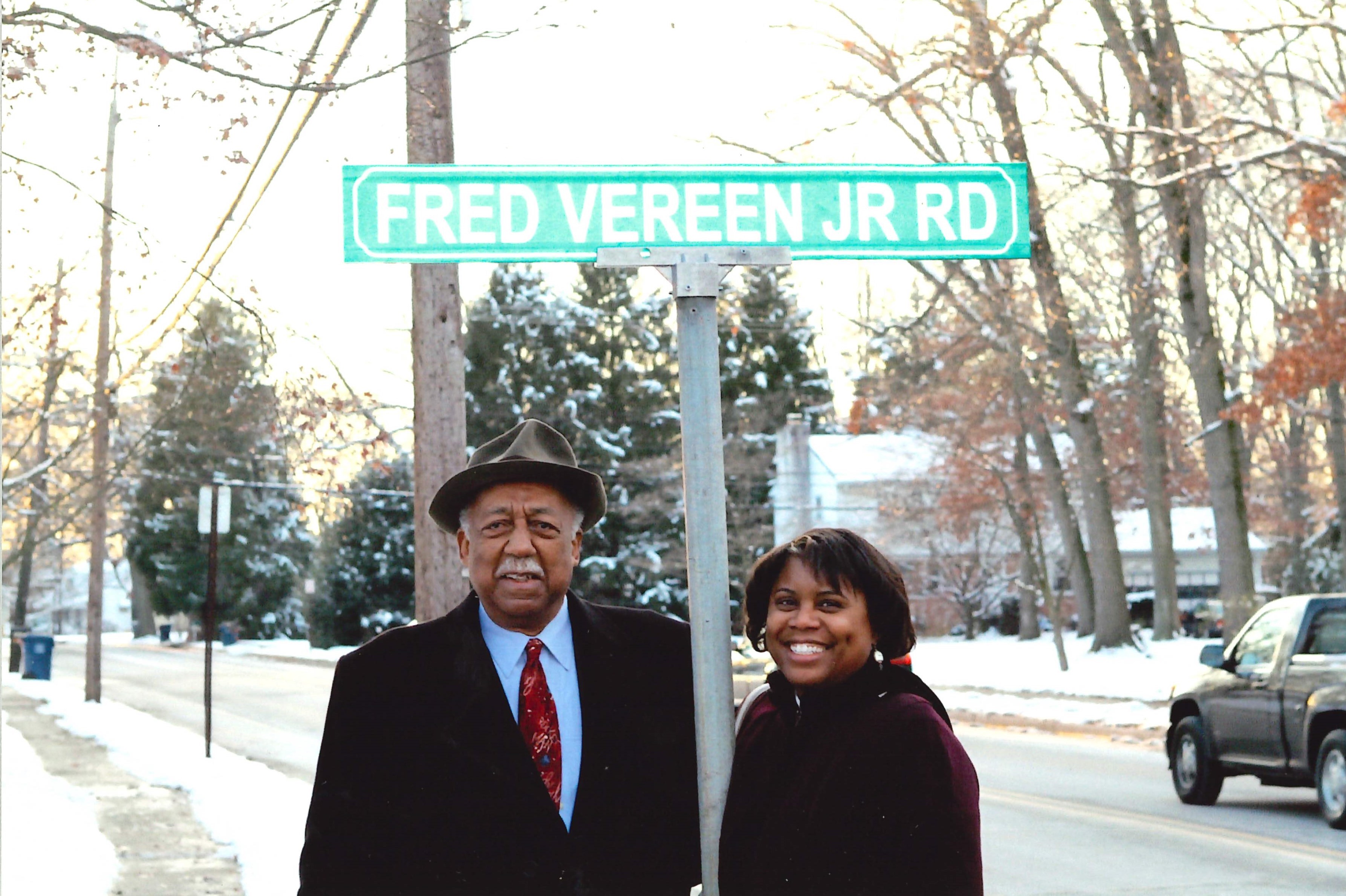 Figure 3: Mr. Vereen and Crystal Edwards at the street that bears his name in Lawrence Township, NJ (2008) "She was superintendent of Lawrence Township School District when this picture was taken."
-----------------------------------------END OF TRANSCRIPT----------------------------------------------
Transcribed by Jesse Braddell 6/4/2024
Reviewed by Shaun Illingworth 9/16/2024
Reviewed by Fred Vereen, Jr. 10/31/2024